
Different Types of AI Tools Explained (Text, Voice, Automation, Research)
Artificial Intelligence (AI) tools have significantly transformed how we work, communicate, and process data. From text generation to voice recognition, automation, and research support, AI has carved its niche in various domains, offering solutions that enhance efficiency, accuracy, and productivity.
1. Text-Based AI Tools: Revolutionizing Communication and Content Creation
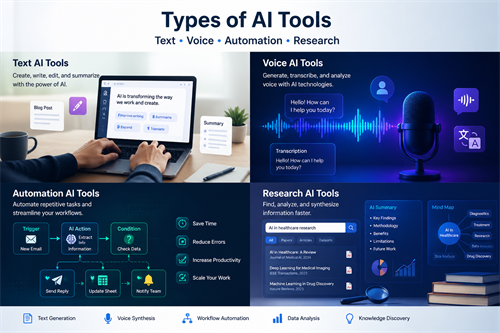
Text-based AI tools are perhaps the most widely recognized and used type of AI today. These tools use Natural Language Processing (NLP) to understand, generate, and manipulate human language. They are the backbone of applications like chatbots, content generation software, and text analysis tools.
Applications and Use Cases:
Content Generation: Tools like GPT-4 and other large language models (LLMs) are capable of writing articles, creating blog posts, and generating marketing copy. These tools can help businesses, bloggers, and writers save time and overcome writer's block.
Email and Text Responses: Many professionals use AI-powered assistants like Grammarly, Hemingway Editor, or even Outlook's AI features to draft and refine emails and other written communication. These tools can help with grammar checking, tone adjustments, and clarity improvements.
Translation and Localization: AI tools like Google Translate and DeepL have made real-time translation easier than ever. These tools are increasingly sophisticated, offering nuanced translations that cater to diverse cultures and languages.
Sentiment Analysis and Text Mining: Businesses use AI-driven sentiment analysis tools to analyze customer feedback, social media posts, and reviews. These tools can determine the tone behind the text (positive, negative, neutral), providing insights into customer satisfaction or the success of a marketing campaign.
Practical Tip:
If you’re a content creator or marketer, integrating text-based AI tools into your workflow can vastly improve productivity. Use AI for drafting initial content, then refine it manually to ensure it fits your brand’s voice and messaging.
2. Voice-Based AI Tools: Transforming Communication and Accessibility
Voice-based AI tools leverage speech recognition and natural language processing to allow users to interact with machines using spoken language. These tools have become integral in industries ranging from healthcare to customer service.
Applications and Use Cases:
Speech-to-Text: AI-powered transcription tools like Otter.ai or Rev are widely used to transcribe meetings, interviews, or podcasts. These tools save hours of manual transcription work, and their accuracy has improved significantly, thanks to machine learning.
Voice Assistants: Popular voice assistants like Siri, Google Assistant, and Alexa help users complete tasks like setting reminders, checking the weather, and controlling smart home devices. These tools are powered by sophisticated AI models that understand and respond to user queries.
Voice Recognition for Security: AI-driven voice recognition systems are increasingly being used in security, such as for authentication or fraud prevention in banking apps, where voice biometrics can verify a person’s identity based on their unique vocal patterns.
Language Translation: Voice-to-text translation tools, such as Google Translate's conversation mode, allow users to translate spoken language in real time, bridging communication gaps between different languages and cultures.
Practical Tip:
For businesses that handle a high volume of customer service calls, integrating AI-powered voice assistants or transcribing tools can improve efficiency and free up human agents to handle more complex issues. Additionally, voice recognition for authentication can improve security and customer satisfaction.
3. AI for Automation: Streamlining Operations and Improving Efficiency
Automation tools powered by AI are transforming business operations, particularly in fields like marketing, HR, finance, and logistics. These tools leverage machine learning algorithms to automate repetitive tasks, freeing up human employees to focus on higher-value work.
Applications and Use Cases:
Robotic Process Automation (RPA): RPA tools like UiPath and Blue Prism automate routine tasks such as data entry, invoice processing, and customer onboarding. These tools mimic human actions in software interfaces, reducing the need for manual intervention.
AI Chatbots: AI-powered chatbots are used extensively in customer service and e-commerce. Tools like Intercom, Drift, and Zendesk can automatically handle customer inquiries, book appointments, and troubleshoot common issues. They reduce the need for live agents while improving the customer experience.
Predictive Analytics: AI-powered automation tools are capable of analyzing large datasets and making predictions about future trends. For example, in marketing, AI tools can automatically adjust ad spending based on real-time performance data. In supply chain management, predictive analytics can forecast demand and optimize inventory management.
Automated Scheduling: Tools like Calendly and Doodle use AI to automatically schedule meetings and coordinate availability between participants, saving time and reducing the back-and-forth of email scheduling.
Practical Tip:
Start small by automating one or two recurring tasks in your daily workflow. For instance, using an AI chatbot for customer queries or scheduling meetings automatically can drastically cut down the time spent on administrative tasks.
4. AI for Research: Enhancing Data Analysis and Discovery
AI tools have become essential in research, whether for academic studies, market research, or data analysis. These tools are helping researchers process vast amounts of data, uncover insights, and make predictions with greater accuracy.
Applications and Use Cases:
Data Mining and Analysis: AI-driven research tools like IBM Watson and Google Cloud AI help researchers analyze complex datasets, uncover patterns, and generate actionable insights. These tools use machine learning algorithms to automate the discovery of trends that would be difficult for humans to identify manually.
AI in Drug Discovery: In fields like pharmaceuticals, AI tools such as BenevolentAI and Atomwise use algorithms to simulate and predict the effects of drug molecules. This accelerates the research process and reduces the time it takes to bring new drugs to market.
Literature Review Automation: Tools like Iris.ai and Connected Papers use AI to help researchers find and review academic papers in their field. By analyzing paper abstracts, these tools suggest relevant research papers and topics that can enrich a literature review or a research project.
AI in Market Research: In business research, AI tools are used to analyze consumer behavior, market trends, and competitive landscapes. Tools like Tableau, Power BI, and Google Analytics use AI to generate reports and insights that help businesses make data-driven decisions.
Practical Tip:
For researchers, integrating AI tools into your data collection and analysis workflow can save significant time. Whether you’re sifting through literature or analyzing datasets, AI tools help you stay ahead by providing deeper insights faster and more efficiently.
Conclusion: The Practical Impact of AI Tools in Your Workflow
AI tools, whether for text, voice, automation, or research, offer practical solutions to problems that have historically been time-consuming or inefficient. They allow individuals and businesses to automate mundane tasks, create high-quality content faster, improve communication, and make more informed decisions based on data analysis. While adopting these tools requires some learning, the return on investment is clear: improved productivity, cost savings, and more time for creative and strategic work.
To make the most of these tools, start by identifying areas in your work where AI can bring tangible improvements. For example, use text-based AI tools to streamline content creation, voice assistants for hands-free tasks, automation tools to manage workflows, and research tools to gain deeper insights from data.
By implementing the right AI tools into your workflow, you can unlock new possibilities, enhance efficiency, and stay ahead in an increasingly automated world.
Recommend for you:
Are Paid AI Tools Worth It or Are Free Tools Enough?
The real question is not whether paid AI tools are “worth it” in general.
Is It Better to Prompt Once or Iterate Multiple AI Prompts?
The answers looked correct, even impressive, but they didn’t help him think better.
When AI Over-Automation Creates More Work Instead of Less
The point at which automation stops being leverage and starts becoming overhead.
Should You Use AI During Brainstorming or After Ideas Are Formed?
Should AI be part of the brainstorming process itself, or should it only come in after you’ve already formed your ideas?